



Every real estate developer in India has this story.
You spend ₹8 lakhs on portal listings and Google ads in a single month. Hundreds of inquiries flood in — from MagicBricks, 99acres, Housing.com, Facebook, Google. Your sales team gets busy. The site visit calendar fills up for a week.
And then, somehow, at month-end, the numbers don't add up.
Leads came in. Follow-ups didn't happen. Prospects went cold. Some called back asking why no one reached out. A few already booked with a competitor. Your sales manager is pointing at the marketing team. Marketing is pointing at sales. And the ₹8 lakhs? You have very little to show for it.
This is not a people problem. This is a systems problem.
And it is costing Indian real estate businesses crores every year.
1. The Real Cost of Not Having a CRM in Real Estate
Before we talk about software, let's talk about what's actually happening in your business.
Lead Leakage Is More Expensive Than You Think
Research across sales-intensive industries shows that over 60% of inbound leads are never followed up with more than once. In real estate — where the average buyer needs 5–8 touchpoints before making a decision — a single missed follow-up can mean losing a ₹80 lakh flat.
Here's a simple math exercise:
Assume your project generates 200 leads per month. If even 30% are never properly followed up (a conservative estimate for teams without a CRM), that's 60 leads gone. If your conversion rate from lead to booking is 5%, you've just lost 3 potential bookings per month. At ₹70 lakhs per unit, that's ₹2.1 crore in revenue leakage per month — not because of bad leads, but because of missing systems.
The WhatsApp-Excel Trap
Most real estate sales teams in India are stuck in what we call the WhatsApp-Excel Trap:
- Leads are shared in a WhatsApp group
- Someone copies them into a shared Excel sheet
- Follow-up happens informally, by whoever remembers
- No one knows which version of the sheet is current
- Managers spend Friday afternoons manually asking "where is this lead?"
- When a salesperson leaves, their leads leave with them
This setup worked fine when you were handling 30–50 leads a month. It breaks completely when you're handling 200+.
If any of this sounds familiar, you're not alone. Most real estate teams in India are losing leads every week without realizing it. See how Erino gives you complete lead visibility in under 48 hours — Book a Free Demo.
2. Why Real Estate Leads Go Cold (And How to Stop It)
The 5-Minute Rule — and Why Most Teams Miss It
Studies in sales psychology consistently show that the probability of qualifying a lead drops by 21x if you wait more than 5 minutes to call them after they inquire. In real estate, where buyers are often comparing 5–8 projects simultaneously on portals, being second to call can mean being last in consideration.
Without a CRM, real estate teams face a structural problem: leads arrive in multiple places (email, portal dashboards, WhatsApp, website), get copied manually, and assigned informally — by which point 15–30 minutes may have already passed.
The Follow-Up Gap
Even when leads are called promptly, the follow-up journey typically looks like this without a CRM:
- Call 1: Introduction, send brochure on WhatsApp
- Call 2: "Did you get our brochure?" (if this even happens)
- Call 3: Rarely
The buyer needed 6 more touchpoints. They got 2.
A CRM with automated follow-up reminders closes this gap systematically, without depending on individual salespeople to "remember."
Site Visit Scheduling: Where Conversions Are Won or Lost
For most Indian real estate projects, the site visit is the pivotal moment. Buyers who visit a site convert at dramatically higher rates than those who don't. But site visits require coordination — confirming timing, sending directions, reminding the buyer, ensuring the right salesperson is present.
Without a system, this coordination falls apart:
- Buyers confirm, then don't show up because no one sent a reminder
- Salesperson double-books
- Wrong unit inventory is shown because there was no briefing
A proper CRM handles site visit scheduling, reminders, and post-visit follow-up in a single workflow.
3. What Real Estate Teams Actually Need from a CRM
Let's be specific. Here is what a CRM for real estate in India must deliver — not in theory, but operationally:
Lead Aggregation from All Sources
Your leads are coming from:
- Housing.com, 99acres, MagicBricks (API or email parser)
- Facebook and Google Ads (via form integrations)
- Your website contact forms
- Walk-in registrations
- Reference/broker leads (manual entry)
- IVR / missed call campaigns
A good CRM captures all of these in one place automatically, eliminating the copy-paste workflow entirely.
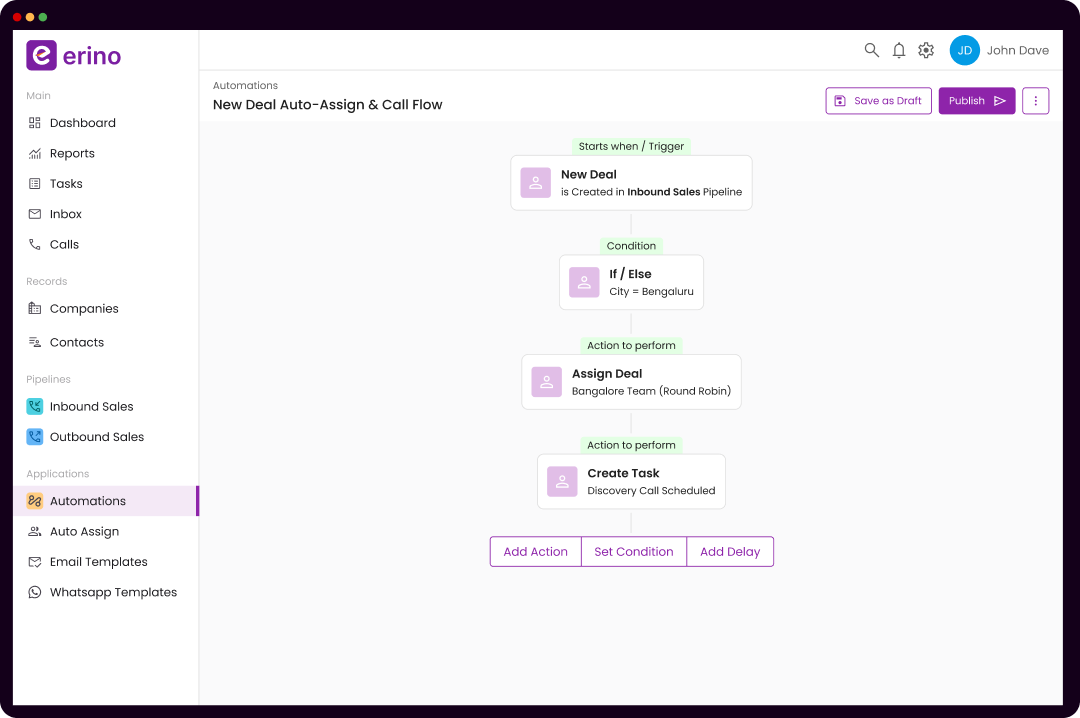
Instant Lead Assignment with Accountability
As soon as a lead comes in, it must be assigned to a specific salesperson. That assignment must be time-stamped, and the system must track whether the call was made and when. Managers need to see this in real time — not on Friday.
Automated Follow-Up Sequences
Not every buyer is ready to visit in week one. Some are 3–6 months from a decision. A CRM must allow you to set up multi-touch follow-up sequences — calls, WhatsApp messages, emails — that run automatically until the prospect responds or opts out.
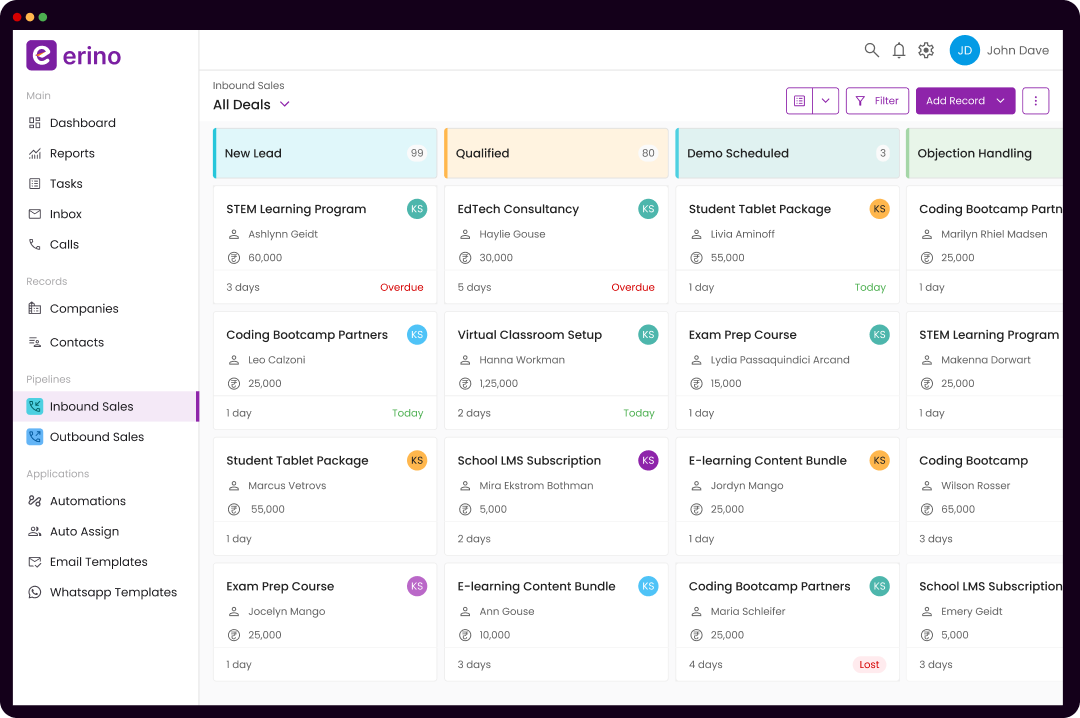
Pipeline Visibility by Stage
Real estate sales have clear stages: Inquiry → Contacted → Site Visit Scheduled → Site Visit Done → Negotiation → Booked. Every lead should sit in one of these stages, and your dashboard should tell you instantly how many leads are in each stage, and which ones are stagnating.
Team Performance Tracking
How many calls did each salesperson make today? How many leads did they move forward? How many site visits did they book? These should not require a manual report — they should be on your manager dashboard.
4. Why Generic CRMs Often Fail Real Estate Teams
This is where many developers and brokers get burned.
They buy Salesforce or HubSpot, spend 3 months on implementation, realize the team never adopted it, and go back to Excel. The CRM sits unused, and the business concludes "CRMs don't work for us."
The real issue is not CRMs. It's complexity.
Enterprise CRMs are built for large corporations with dedicated IT teams, Salesforce administrators, and months for onboarding. They are extraordinarily powerful — and extraordinarily difficult to set up and use for a 10–30 person real estate sales team.
Meanwhile, very basic CRMs offer a contact list with reminders but no pipeline visibility, no automation, and no reporting.
Real estate teams need something in between: a CRM powerful enough to handle serious lead volumes, but simple enough that every salesperson actually uses it from day one.
6. How the Best Real Estate CRMs Operate: A 7-Step Workflow
This is what your lead journey should look like with the right CRM in place:
Step 1 — Lead Capture: Inquiry arrives from any source (portal, ad, walk-in) and is automatically logged in the CRM with source attribution.
Step 2 — Instant Assignment: Lead is assigned to a specific salesperson immediately — either by rule (round-robin, area-based, project-based) or manually by the manager.
Step 3 — First Call within 5 Minutes: Salesperson receives a notification and is expected to call within 5 minutes. CRM tracks call time.
Step 4 — Stage Update: After the call, salesperson updates the stage — Not Reachable, Interested, Site Visit Requested, etc.
Step 5 — Automated Follow-Up: Based on stage, follow-up tasks and reminders are automatically created. WhatsApp templates are queued.
Step 6 — Site Visit Scheduling: When prospect is ready, the site visit is scheduled inside the CRM, with automatic reminders to both prospect and salesperson.
Step 7 — Post-Visit Follow-Up: After site visit, a structured follow-up sequence begins — negotiation support, document checklist, booking assistance.
Every step is tracked. Nothing falls through the cracks.
7. What Makes Erino CRM Different for Real Estate Teams in India
Erino is not a generic CRM with a real estate label attached.
It is built from the ground up for the operational reality of Indian sales teams: teams that move fast, use WhatsApp more than email, have high salesperson turnover, and need managers to have full visibility without chasing their team for updates.
Here is what makes the difference:
1. Simplicity that drives adoption. Erino is India's easiest CRM. Most salespeople are fully operational within a few hours — no training sessions, no manuals. This matters more than any feature list, because a CRM no one uses is worthless.
2. Omnichannel communication built in. WhatsApp, email, and call logging are integrated natively. Salespeople communicate with prospects the way they naturally would — and every interaction is automatically logged.
3. Real-time pipeline visibility. Managers can see every lead, every stage, and every salesperson's activity from a single dashboard. Without sending a single WhatsApp message asking for an update.
4. Automated follow-ups that actually run. Follow-up sequences don't require a technical team to configure. You set them up in minutes, and they run — keeping your prospects warm across every stage of the sales cycle.
5. Fast setup for Indian real estate. No 3-month implementation. No IT dependency. Erino is operational in under 48 hours, with your lead sources integrated and your fully customizable pipeline stages configured for real estate.
8. Common Reasons CRM Implementations Fail in Real Estate
Understanding why other teams failed helps you implement correctly.
Reason 1: The CRM was too complex. Salespeople found it easier to go back to WhatsApp. Solution: Choose a CRM with a clean, intuitive interface that requires zero training.
Reason 2: No management enforcement. The CRM was bought but managers never made it mandatory. Solution: Begin using the CRM dashboard as your sole source of truth in team meetings from day one.
Reason 3: Leads weren't integrated automatically. The team had to manually enter leads from portals, which felt like extra work. Solution: Insist on automatic lead capture from your portal sources before going live.
Reason 4: No mobile app. Field sales teams in real estate can't work from desktop. Solution: Verify mobile app quality during the demo phase.
Reason 5: No one owned the implementation. Everyone assumed someone else would set it up. Solution: Assign one internal champion — typically a sales manager — who is responsible for CRM adoption.
9. How to Evaluate a Real Estate CRM: 10 Questions to Ask in Your Demo
Before committing to any CRM, ask the vendor:
- How do leads from 99acres, Housing.com, and MagicBricks get into your system? Is it automatic?
- Can I see a real-time dashboard of my team's call activity?
- Does the system support WhatsApp communication with lead logging?
- How long does setup typically take for a team like mine?
- What does the mobile app look like? Can I see it on my phone right now?
- Can I set follow-up sequences that run automatically for 30–90 days?
- How do I track the source of each booking (which portal, which campaign)?
- What happens when a salesperson leaves — are their leads reassigned automatically?
- Is there a limit on the number of leads I can store?
- What does support look like if I have issues during onboarding?
10. The Revenue Math of Getting CRM Right
Let's return to the math from earlier — but now with a CRM in place.
Same 200 leads per month. With a CRM:
- Lead response time drops from 30+ minutes to under 5 minutes → significantly higher contact rates
- Follow-up compliance rises from 40% to 85%+ because reminders are automated
- Site visit scheduling is structured, with reminders, reducing no-shows
Conservative improvement in conversion rate: from 5% to 7.5%.
That's 15 bookings instead of 10 per month.
At ₹70 lakhs per unit, the difference is ₹3.5 crore in additional monthly revenue.
The CRM costs a fraction of one booking.
If you're managing more than 100 leads a month and you don't have a CRM that every salesperson is actively using, you are leaving money on the table every single day. Erino is built for exactly this situation — simple enough for instant adoption, powerful enough for serious real estate operations.
Book a Free Demo with Erino — See Your Pipeline in 48 Hours
FAQ: CRM for Real Estate in India
Q. What is the best CRM for real estate agents in India?
A. The best CRM for real estate in India combines automatic lead capture from Indian portals (99acres, Housing.com, MagicBricks), WhatsApp integration, automated follow-up sequences, and a pipeline dashboard that managers can check in real time. Erino CRM is designed to meet all of these requirements while being simple enough for any salesperson to use from day one, with setup completed in under 48 hours.
Q. Why do real estate leads go cold so quickly?
A. Real estate buyers are comparing multiple projects simultaneously. If they don't hear from you within 5–10 minutes of inquiring, they're already engaged with a competitor. Most leads go cold not because the buyer lost interest, but because the follow-up was delayed, missed, or too infrequent. A CRM with automated reminders and follow-up sequences solves this structurally.
Q. How much does a real estate CRM cost in India?
A. CRM pricing in India ranges from ₹500 to ₹5,000+ per user per month depending on features. Enterprise CRMs like Salesforce or HubSpot can cost significantly more and require implementation budgets. Erino offers competitive pricing tailored to Indian real estate teams, with transparent per-seat pricing and no hidden costs.
Q. Can a small real estate team (5–10 people) benefit from a CRM?
A. Yes — often more than large teams. Small teams have less margin for error; every missed lead matters more. A CRM ensures that even a 5-person sales team operates with the discipline and visibility of a 50-person team.
Q. How long does it take to implement a CRM for real estate?
A. With the right CRM, implementation takes 24–72 hours. This includes configuring pipeline stages, integrating lead sources, and briefing the sales team. Avoid any CRM whose vendor suggests a timeline of more than 2 weeks — complexity at setup will translate to complexity in daily use.
Q. What is the difference between a real estate CRM and a general CRM?
A. A real estate CRM is configured for property sales workflows: portal lead integrations, site visit scheduling, unit inventory tracking, and broker management. A general CRM requires customization to achieve these — which is time-consuming, expensive, and often never completed, leaving the team with a tool that doesn't match their process.
Q. How do I get my sales team to actually use the CRM?T
A. he biggest adoption driver is simplicity. If the CRM is easy to use on mobile and takes less than 60 seconds to log a call or update a lead, salespeople will use it. Pair this with management mandating that all reporting and reviews happen only from CRM data — and adoption follows quickly.