



A real estate sales team in India is coordinating leads from 6+ sources, managing site visits across multiple days, tracking channel partner claims, following up with buyers who went cold 3 weeks ago, and somehow providing the sales head with accurate pipeline data — all simultaneously.
The generic CRM was not built for this. It was built for a sales rep who works from a desk, manages 30–40 leads, and closes in a predictable cycle. Real estate in India is the opposite of all of that.
This guide is for sales heads, builders, and real estate developers who want to understand what a CRM actually needs to do for their specific operational context — and how to evaluate whether a platform genuinely serves it.
In real estate, the gap between a lead enquiring and a booking being confirmed can be 3 weeks to 6 months. The team that follows up consistently across that entire window — not just the first 3 days — wins the deal.
Why Generic CRMs Fail Indian Real Estate Teams
Every large CRM vendor has a real estate vertical. Most are rebranded B2B pipelines with a few real estate field names added. The operational mismatch shows up within the first month of use.
1. No site visit workflow
Site visits in Indian real estate are not just "meetings." They involve scheduling coordination, escort assignment, location sharing, post-visit feedback capture, and immediate follow-up. A CRM that can't manage this natively forces teams back to WhatsApp and calls.
2. CP and broker blind spots
Channel partners source 40–60% of leads for most developers. A CRM that can't track CP source per lead, manage commission claims, or give CPs a lightweight portal to submit and track their leads creates irreversible tracking chaos.
3. Field team abandonment
Sales executives visiting sites, attending walkthroughs, and meeting clients at coffee shops won't open a laptop to log a conversation. If the CRM isn't mobile-first, field activity goes unlogged — which means it effectively didn't happen for the manager.
4. Missed call chaos
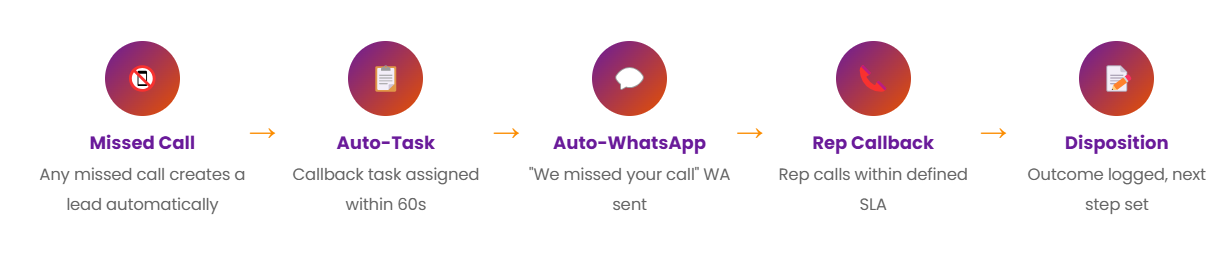
Real estate buyers often call from unknown numbers, miss calls, and expect rapid callback. Without automatic missed-call lead creation and callback task assignment, these high-intent contacts simply vanish.
5. Multi-project inventory gaps
A developer with 3 active projects needs lead-to-unit matching, unit availability visible at point of conversation, and booking status synced in real time. Generic CRMs have no concept of inventory. Teams manage it in Excel alongside the CRM — creating dangerous data inconsistency.
6. Long cycle, low follow-up patience
Real estate has a 90–180 day average decision cycle. CRMs with no automated long-cycle follow-up sequences cause teams to manually abandon leads that are simply "slow" — not cold. This is where the most recoverable revenue goes.
The 6 leakage points in a real estate sales funnel
⚠ The total leakage across these six points is typically 35–40% of all leads — before a single site visit happens. In real estate, each lead represents significant marketing spend. This is recoverable revenue.
Site Visit Coordination — The Highest-Leverage Conversion Moment
A site visit is the single highest-intent signal in the real estate sales funnel. A buyer who visits — and has a well-managed experience — is 4× more likely to book than one who doesn't. Yet most developers manage site visits on WhatsApp groups and personal phone calendars.
What a CRM-managed site visit workflow looks like
1. Site visit scheduling inside the lead record
The assigned sales rep books the visit directly from the CRM — date, time, project location, and escort assigned. The booking appears in the rep's task queue automatically.
2. Automated WhatsApp confirmation to buyer
Immediately on booking: a WhatsApp message with visit confirmation, address, directions link, and contact number of the escort. No manual sending required.
3. Reminder sequence — 24h and 2h before
Automated WhatsApp reminders at 24 hours and 2 hours before the visit. These alone reduce no-show rates by 30–40% for most developers.
4. Visit outcome logged by escort on mobile
After the visit, the escort marks attendance, adds feedback (units shown, buyer reaction, concerns raised), and sets next steps — all from the mobile app, before leaving the site.
5. Post-visit follow-up triggered automatically
Visit marked as Completed triggers: a WhatsApp "Thank you for visiting" message, a callback task for the assigned rep within 4 hours, and the lead moved to "Post-Visit Follow-up" pipeline stage.
The developers who win in a competitive micro-market are not always the ones with the best product. They are the ones whose sales teams follow up three times after the site visit when the competitor follows up once.
— Real estate sales operations observation, Pan-India
Broker & Channel Partner (CP) Management — The Tracking Gap That Costs Crores
For most developers, channel partners source 40–65% of leads and conversions. Yet CP management is routinely the weakest part of the sales operations infrastructure.
Leads submitted by CPs over WhatsApp or phone calls often don't make it into any formal system. Commission disputes arise because there's no clean audit trail. CPs who don't feel valued or informed stop sending leads — and the developer doesn't know until the pipeline dries up.
Core features for channel partner tracking
- CP registration with contact details, RERA ID, and active project assignments
- Lead submission by CP via a unique form link — no WhatsApp chaos, clean records
- Automatic CP tagging on every lead they submit — full audit trail for commissions
- CP-wise conversion reports — identify which brokers send high-intent vs. low-quality leads
- Commission calculation and tracking tied to booking stage — no spreadsheet reconciliation
- CP performance dashboard — so your top-performing brokers know you're watching
- Automated WhatsApp updates to CPs on their lead status — keeps them engaged
WhatsApp Workflows for Real Estate Sales — Automating the Right Touchpoints
Real estate buyers communicate on WhatsApp. They share their requirements, ask for brochures, negotiate over message threads, and make final decisions in conversations. A CRM that doesn't treat WhatsApp as a primary channel is hiding half the sales pipeline from the sales head.
Field Sales Visibility & Team Accountability for Builders
Real estate sales managers typically manage teams where 70–80% of active work happens outside the office — at sites, in client homes, at CPs' offices. Without the right CRM infrastructure, what the manager sees in reports and what the team is actually doing are different realities.
🔍 What sales heads need to see — in real time
- Which leads haven't been called in 48+ hours
- How many site visits are scheduled this week vs. last week
- Which rep has the highest post-visit conversion rate
- Where field execs are during site hours (GPS check-in)
- How many CP leads have come in vs. self-generated
- Pipeline stage distribution and bottleneck stages
- Which leads are at risk of going cold — before they do
⚡ What field reps need to do from their phone
- Add a walk-in on the spot without returning to the office
- Log a site visit with GPS location and photo proof
- Send brochure and floor plan via WhatsApp from the app
- Update lead stage with notes immediately post-meeting
- Flag a hot buyer to sales head with one tap
- Check unit availability before confirming with buyer
- View their task list and priority calls for the day
The GPS check-in reality check
Paper-based visit logs are unreliable by design. In the absence of GPS check-in requirements, visit logs often reflect when a rep said they were at a location — not when they actually were. This isn't malicious; it's the natural result of a system that makes accurate logging inconvenient.
GPS-verified check-ins inside the mobile app create accountability without confrontation. Reps who visit legitimately don't mind — the process takes 3 seconds. Managers get verified data. The behavior shifts because the system makes honesty the path of least resistance.
Call Tracking & Missed Callback Management — No Lead Left Behind
Real estate buyers are often in deliberation mode — comparing 4–6 projects simultaneously. The developer whose team responds to a missed call within 30 minutes, during the evening and weekend windows when buyers are most active, consistently outperforms peers who operate on 9–6 schedules.
Building a missed-call response system
Call analytics that sales heads actually use
- First-response time by rep — average, best, worst across the week
- Call attempt count before connection — how many tries before a lead responds
- Callback SLA compliance — what percentage of missed calls are returned within 30 minutes
- Call-to-site-visit conversion — which reps turn calls into scheduled visits at the highest rate
- Peak call times — when buyers are most reachable, so scheduling and staffing can align
- Call recording review — managers can listen to calls for quality and coaching
Real Estate CRM Platforms in India — Honest Feature Comparison
Multiple platforms claim to serve Indian real estate. Here's what the functional comparison looks like on the features that determine whether your team actually uses the CRM — or routes around it.
Frequently Asked Questions
Q. What is the best CRM for real estate in India?
The best real estate CRM for India is one built specifically for the Indian real estate sales workflow — with site visit management, CP and broker tracking, WhatsApp-native automation, missed call lead creation, and mobile-first field operations. Erino is purpose-built for this use case, including inventory visibility and CP commission tracking. Generic global CRMs like Salesforce or HubSpot require extensive customization to handle these workflows and still fall short on WhatsApp integration and field team adoption. Sell.do has real estate focus but a longer implementation timeline. Erino goes live in 3–5 days.
Q. How do I stop lead leakage in real estate sales?
Lead leakage in real estate is stopped by: (1) Centralizing all leads — portals, walk-ins, missed calls, CP submissions, WhatsApp enquiries — into one CRM, (2) Automating first WhatsApp contact within 60 seconds of lead submission, (3) Setting site visit reminder automation 24h and 2h before each scheduled visit, (4) Creating callback tasks automatically for every missed call, (5) Building re-engagement sequences for leads that go 30+ days without a touchpoint. A CRM with these capabilities eliminates the manual coordination gaps where most real estate lead leakage occurs.
Q. How can a CRM help with site visit management in real estate?
A real estate CRM manages site visits by: scheduling visits inside the lead record with escort assignment, sending automated WhatsApp confirmation and reminders to buyers, logging visit outcomes (attended/no-show) from the escort's mobile, and triggering post-visit follow-up sequences automatically. This eliminates the manual coordination that causes 30–40% no-show rates and post-visit follow-up gaps. Erino's site visit workflow is built into the pipeline — not a separate calendar or tool
Q. How do I track channel partner (CP) leads in a CRM?
CP lead tracking in a real estate CRM works best when CPs have a dedicated submission mechanism — a unique link or lightweight portal — rather than submitting via WhatsApp or phone calls. Each submission is automatically tagged to the CP's record, creating a clean audit trail for commission calculation. The CRM then sends automated status updates to the CP as their lead progresses, keeping brokers engaged and reducing commission disputes. Erino includes CP management as a native feature, not an add-on
Q. Why does CRM adoption fail for real estate field teams?
Field team CRM adoption fails because: (1) The CRM requires a desktop or laptop to use fully, (2) Logging a call or visit takes more than 30 seconds on mobile, (3) The system doesn't integrate WhatsApp, forcing reps to manage two apps simultaneously, (4) The CRM feels like a surveillance tool rather than something that makes the rep's job easier. The fix is a mobile-first CRM where field reps can add leads, log visits with GPS, send WhatsApp templates, and update pipeline stages — all from their phone, in under 30 seconds per action.
Q. What WhatsApp automation is useful for real estate sales?
The highest-impact WhatsApp automations for real estate are: (1) Auto-welcome + brochure within 60 seconds of enquiry, (2) Missed call acknowledgment with callback availability, (3) Site visit confirmation + directions immediately on scheduling, (4) 24h and 2h pre-visit reminders (reduces no-shows by 30–40%), (5) Post-visit thank you + floor plan + EMI calculator, (6) 30-day re-engagement for cold leads with project updates or new inventory. These automations ensure consistent touchpoints at every high-leverage moment — without rep dependency.
Q. How is Erino different from Sell.do for real estate CRM?
Both Erino and Sell.do serve the Indian real estate market. Erino's primary differentiators are: faster implementation (3–5 days vs. 2–3 weeks for Sell.do), native WhatsApp automation without additional integration cost, a fully mobile-first field app, and a pricing model designed for small-to-mid-size developers and sales teams. Erino is also built for both real estate and EdTech sales — which matters for developers who also run investor or NRI sales channels requiring a different workflow. Learn more about Erino's real estate CRM here.
Q. Can I use Erino for multiple real estate projects simultaneously?
Yes. Erino supports multi-project visibility — each project can have its own pipeline stages, lead sources, assigned team, and inventory configuration. Sales heads see all projects in a unified dashboard, with the ability to drill down by project, team, or individual rep. Lead routing logic can be configured to direct specific source enquiries to the appropriate project team. This is particularly useful for developers managing 2–5 active projects with different sales teams and pricing